
Keyspaces, tables and CQL reads on Apache Cassandra and CQL-compatible services. Changes wait for approval.
The screenshots show GateRook 2.0.0: the Apache Cassandra form, the endpoint selector, and this connector’s actual tool preview. The form and preview have not been saved. Select a screenshot to open it at full size.
1. Create a connection and enter the settings
In GateRook, open Connections, select Add connection, search for Apache Cassandra, choose its card and select Continue to configure. GateRook downloads the official Apache Cassandra connector module when you choose it. Wait for the download and verification to finish before configuring the connection.
Collect one or more Cassandra contact points and the local data-center name. GateRook discovers other nodes from those contact points, so the computer must be able to reach the advertised node addresses.
Prepare a Cassandra user with the required keyspace permissions and the cluster’s CA certificate if it uses a private CA. Prefer a user limited to reads when changes are unnecessary.
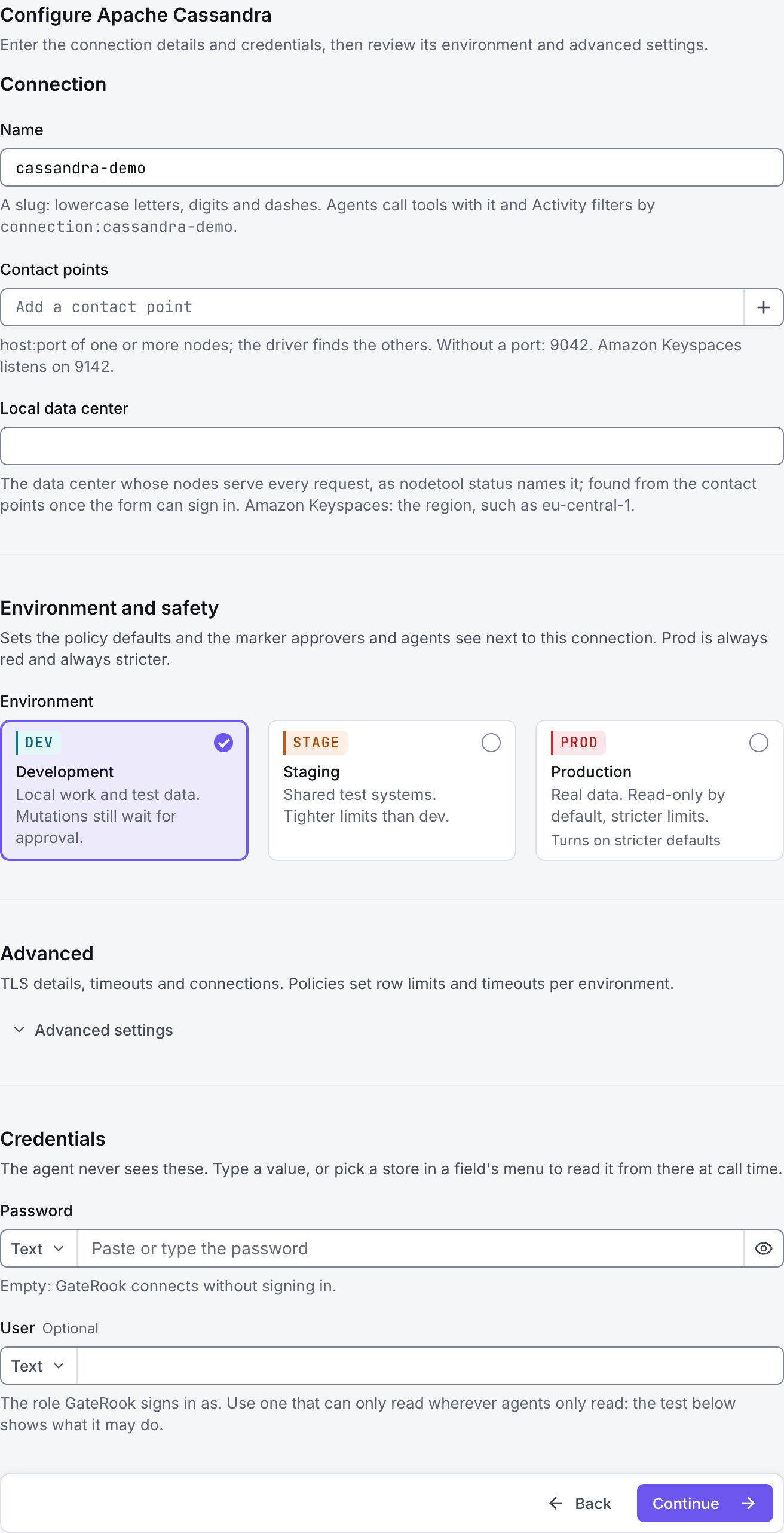
Enter a Name, for example cassandra-demo. Your AI app uses this name to choose the connection.
Enter Contact points as host:port, commonly using port 9042, and verify Local data center against the cluster’s configuration.
Set an optional default Keyspace and restrict Keyspaces to those the AI may use. Enter User and Password.
Choose TLS under Connection type for an encrypted cluster. Keep host-name verification, provide CA certificate (PEM) when required and review Read consistency.
Choose Development, Staging or Production to match the service. Review the connector’s limit and access settings before continuing.
2. Test the connection and add it to an endpoint
Select Continue to test. GateRook checks the settings from your computer. Review the result and resolve any connection, certificate or permission error before continuing.
If only the contact point is reachable, later requests may fail when the driver discovers other nodes. Check the advertised addresses, data-center spelling, TLS host names and user grants before retrying.
After the test passes, select Continue to add to an endpoint. Choose the endpoint your AI app uses, review its tool modes, then select Save connection. GateRook offers default as the starter endpoint.

3. Use the connection from your AI IDE
After saving Apache Cassandra on the endpoint and passing its connection test, ask your AI app to use cassandra-demo, or the name you chose. If its tools are missing, confirm the endpoint assignment and refresh the MCP connection or start a new chat.
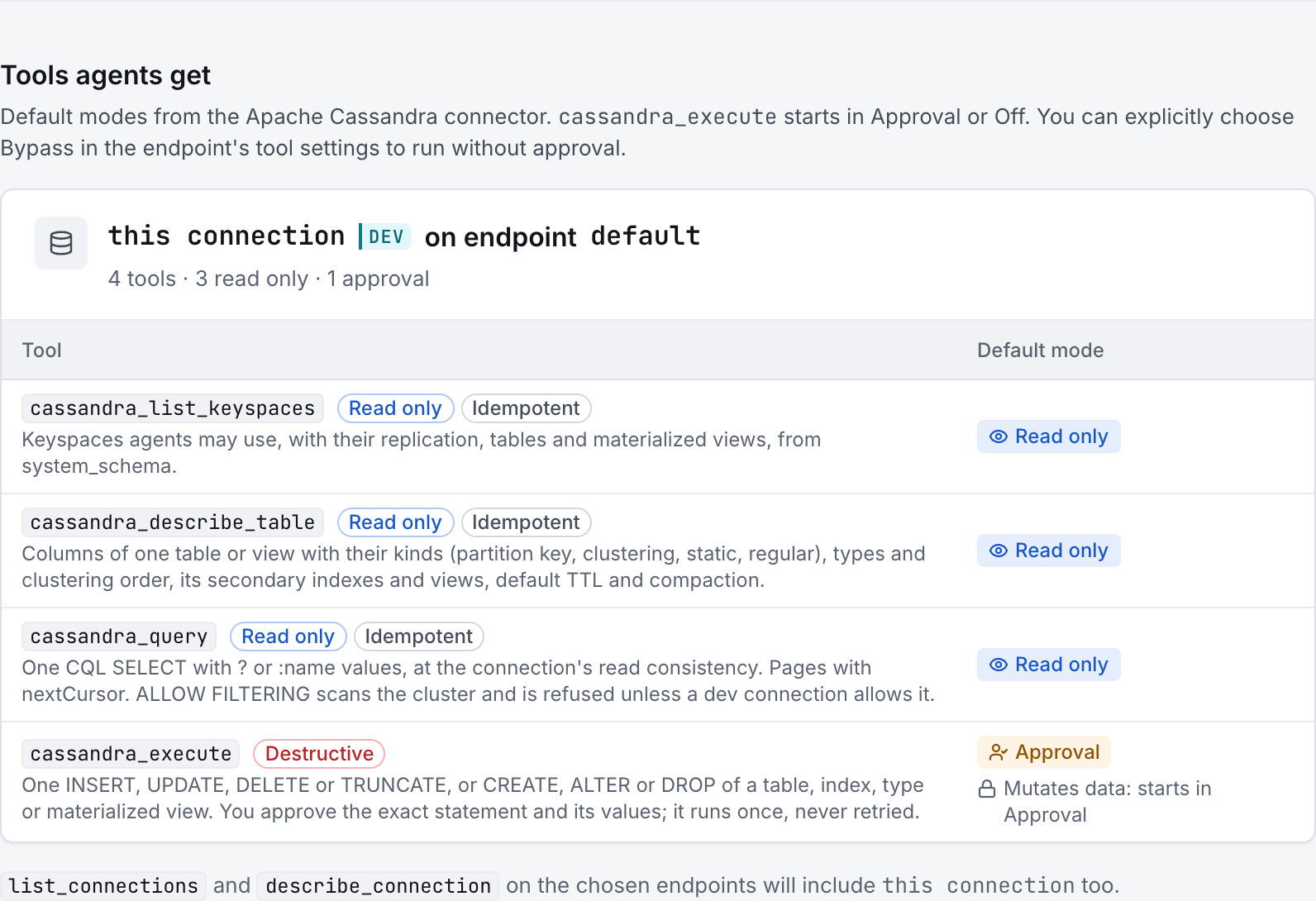
The preview below shows this connector’s default tools before saving. The table explains what each tool can do; connection settings, credentials and endpoint policies can restrict access further.
Start with a small read request. Replace example resource names with existing resources your connection may access. Open Activity after the call to inspect its connection, tool, arguments, policy decision and result metadata.
Ask your AI, for example
- “List the keyspaces and tables available through cassandra-demo.”
- “Describe the partition and clustering keys of shop.orders on cassandra-demo.”
- “Using cassandra-demo, read five orders for the known customer partition key customer-123 without ALLOW FILTERING.”
| Tool | What it does | Starts as |
|---|---|---|
cassandra_list_keyspaces | Keyspaces agents may use, with their replication, tables and materialized views, from system_schema. | Read only |
cassandra_describe_table | Columns of one table or view with their kinds (partition key, clustering, static, regular), types and clustering order, its secondary indexes and views, default TTL and compaction. | Read only |
cassandra_query | One CQL SELECT with ? or :name values, at the connection's read consistency. Pages with nextCursor. ALLOW FILTERING scans the cluster and is refused unless a dev connection allows it. | Read only |
cassandra_execute | One INSERT, UPDATE, DELETE or TRUNCATE, or CREATE, ALTER or DROP of a table, index, type or materialized view. You approve the exact statement and its values; it runs once, never retried. | Approval |
You can change each tool’s mode on the endpoint. Every call your AI makes appears in Activity.