
PocketBase uses GateRook’s SQLite connector. Choose pb_data/data.db in PocketBase's folder. Approved changes skip PocketBase's API rules, hooks and realtime events.
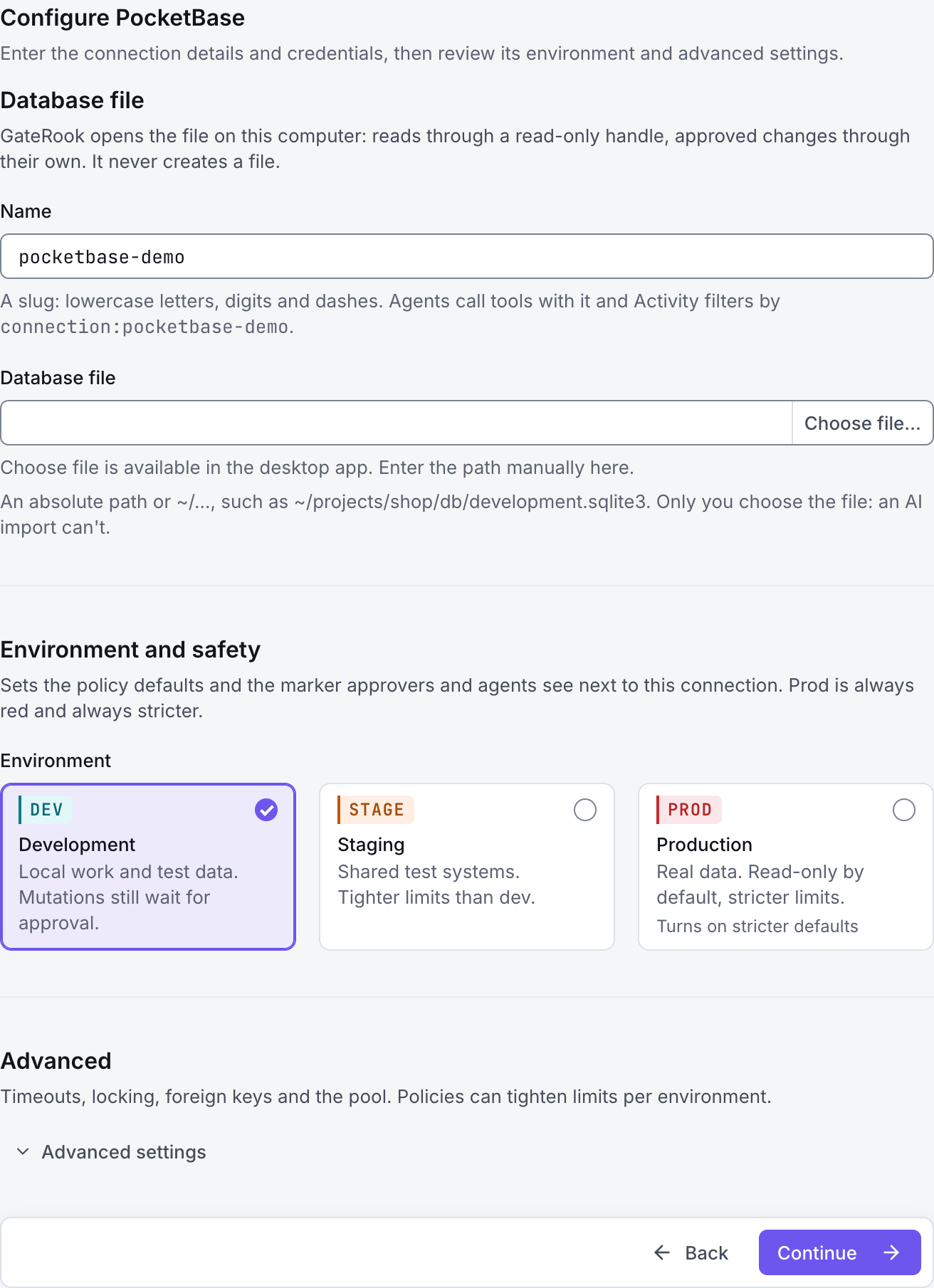
The screenshots show GateRook 2.0.0: the PocketBase form, the endpoint selector, and this connector’s actual tool preview. The form and preview have not been saved. Select a screenshot to open it at full size.
1. Create a connection and enter the settings
In GateRook, open Connections, select Add connection, search for PocketBase, choose its card and select Continue to configure.
Locate the PocketBase application's SQLite database file, normally pb_data/data.db. The file must be accessible on the computer running GateRook; a PocketBase website URL is not a SQLite file.
Direct SQLite access operates below PocketBase's collection API. Collection access rules, hooks and realtime notifications are not a substitute for controlling who can open the database file.
Enter a Name, for example pocketbase-demo. Your AI app uses this name to choose the connection.
Enter the absolute path in Database file, or choose the file with the picker. Select the application's data.db, rather than an unrelated auxiliary database.
Use the connection's Name to identify which PocketBase environment the file belongs to. Set Environment to match that environment.
Keep the default Advanced settings initially. If the database is busy, use a reasonable Lock wait rather than requesting unbounded queries.
Choose Development, Staging or Production to match the service. Review the connector’s limit and access settings before continuing.
2. Test the connection and add it to an endpoint
Select Continue to test. GateRook checks the settings from your computer. Review the result and resolve any connection, certificate or permission error before continuing.
A missing-file error means the path must be corrected on the GateRook computer. A locked-database error calls for checking the running PocketBase process and the chosen file. Begin with schema and bounded read queries; direct writes can bypass PocketBase behavior.
After the test passes, select Continue to add to an endpoint. Choose the endpoint your AI app uses, review its tool modes, then select Save connection. GateRook offers default as the starter endpoint.

3. Use the connection from your AI IDE
After saving PocketBase on the endpoint and passing its connection test, ask your AI app to use pocketbase-demo, or the name you chose. If its tools are missing, confirm the endpoint assignment and refresh the MCP connection or start a new chat.
For this local-file connection, file permissions and configured path restrictions determine which data can be read or changed.
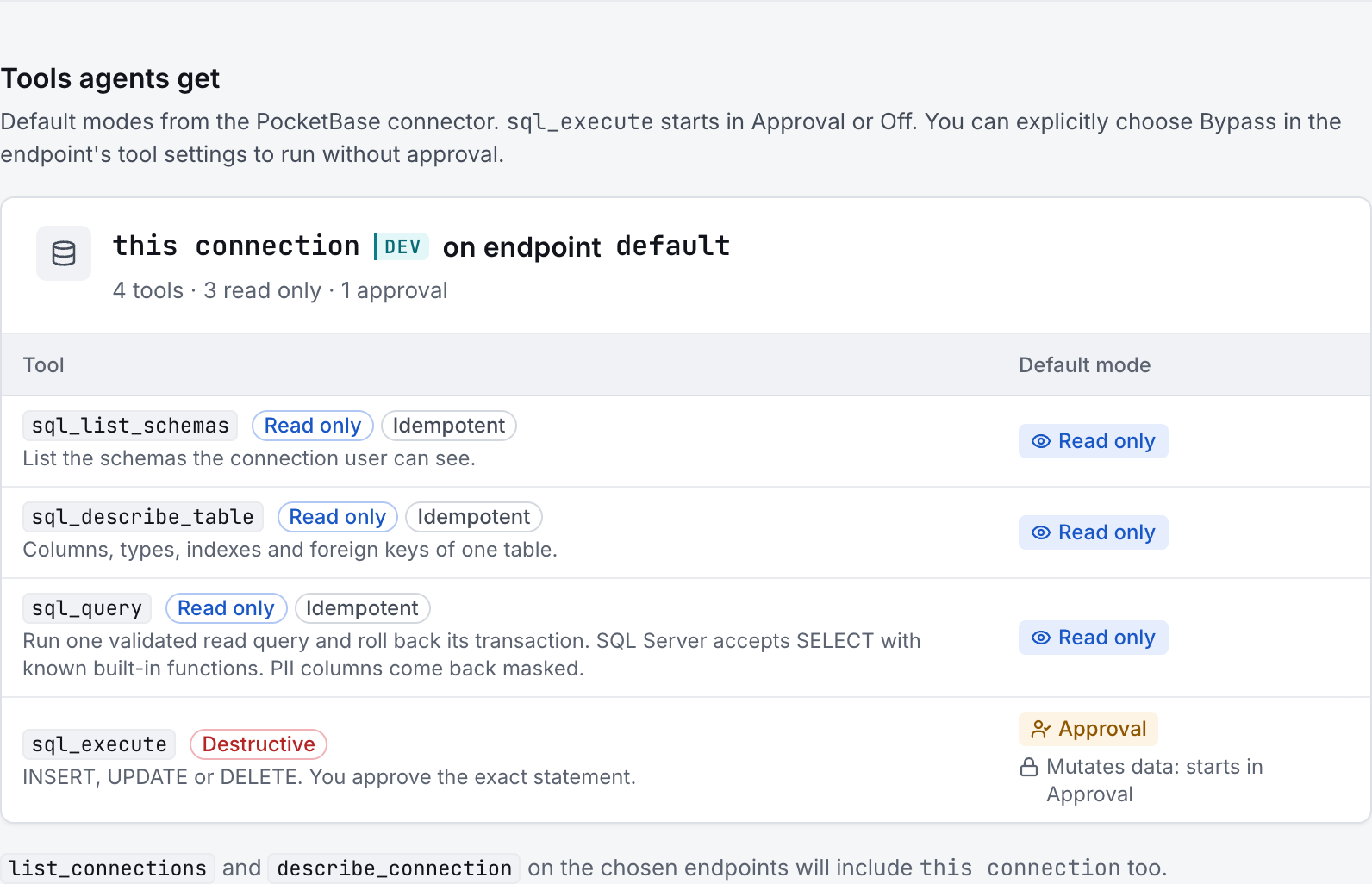
The preview below shows this connector’s default tools before saving. The table explains what each tool can do; connection settings, credentials and endpoint policies can restrict access further.
Start with a small read request. Replace example resource names with existing resources your connection may access. Open Activity after the call to inspect its connection, tool, arguments, policy decision and result metadata.
Ask your AI, for example
- “List the tables in this PocketBase SQLite database.”
- “Describe the columns and indexes of the orders table, if present.”
- “Read at most 10 order records and summarize their statuses without changing data.”
| Tool | What it does | Starts as |
|---|---|---|
sql_list_schemas | List tables and views in the selected local SQLite database file, within the connection and policy restrictions. | Read only |
sql_describe_table | Describe a SQLite table’s columns, types, keys and indexes where available. | Read only |
sql_query | Run one validated SQLite read statement using a read-only file connection, then roll back. Connection and endpoint limits still apply. | Read only |
sql_execute | Run one supported data or schema change with Approval by default, using a separate writable connection. File permissions and the environment policy still apply. | Approval |
You can change each tool’s mode on the endpoint. Every call your AI makes appears in Activity.