
SingleStore uses GateRook’s MySQL connector. SingleStore Helios and self-managed SingleStore through the MySQL protocol.
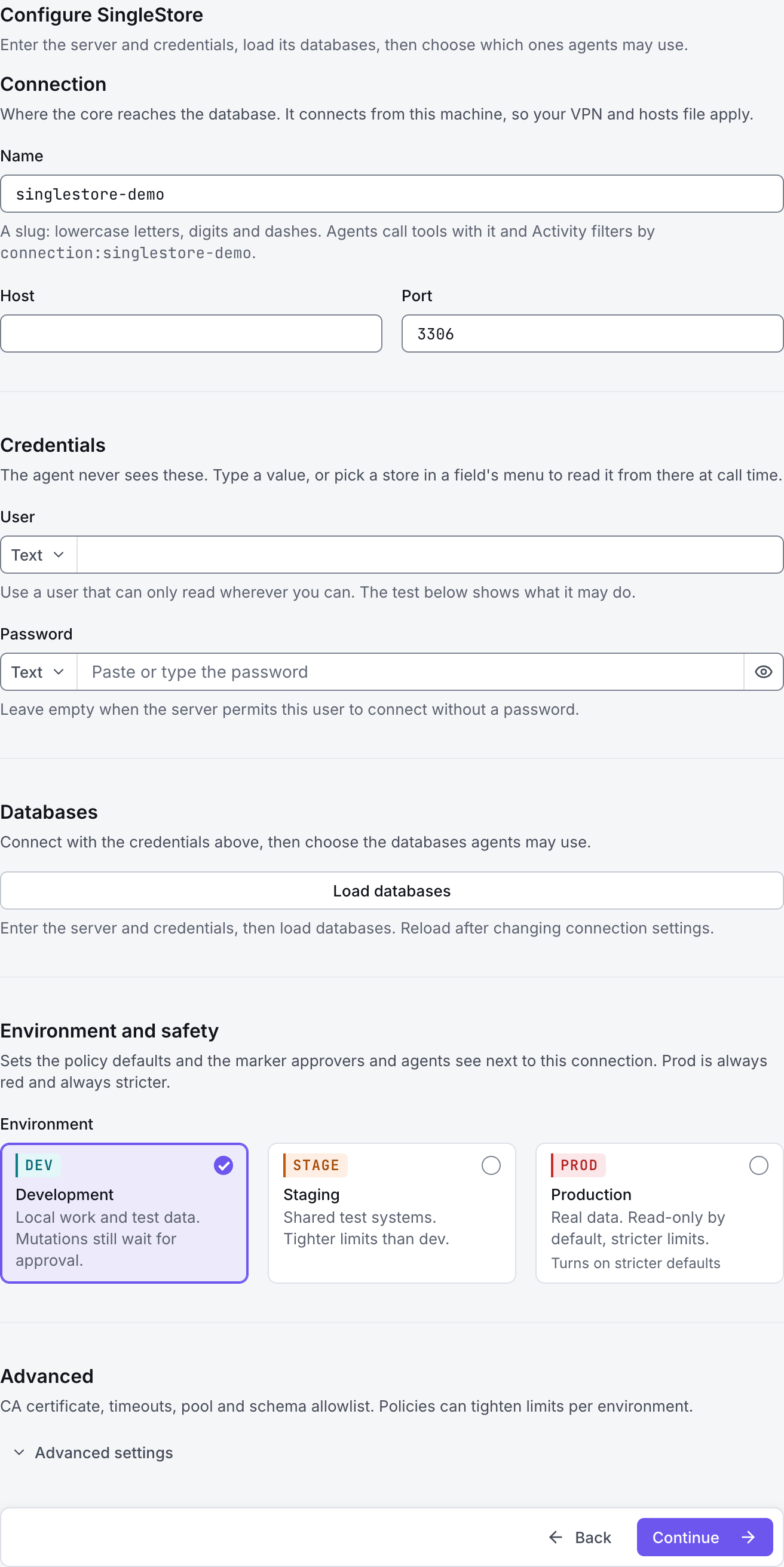
The screenshots show GateRook 2.0.0: the SingleStore form, the endpoint selector, and this connector’s actual tool preview. The form and preview have not been saved. Select a screenshot to open it at full size.
1. Create a connection and enter the settings
In GateRook, open Connections, select Add connection, search for SingleStore, choose its card and select Continue to configure.
For SingleStore Helios, copy the workspace endpoint and database credentials. For a self-managed cluster, use the SQL endpoint supplied by your administrator.
Prepare an account limited to the databases and tables the AI should read.
Enter a Name, for example singlestore-demo. Your AI app uses this name to choose the connection.
Choose SingleStore. Enter a Name, SQL Host, Port, User and Password. Use the endpoint’s actual port; Helios MySQL connections normally use 3306.
For Helios, select verify-full in SSL mode and provide the SingleStore CA bundle in CA certificate (PEM) when required by your trust configuration.
Select Load databases and choose the databases your AI should access. Use Database allowlist if you need a narrower boundary within that selection.
Choose Development, Staging or Production to match the service. Review the connector’s limit and access settings before continuing.
2. Test the connection and add it to an endpoint
Select Continue to test. GateRook checks the settings from your computer. Review the result and resolve any connection, certificate or permission error before continuing.
For a TLS failure, check that the hostname and CA bundle match the selected endpoint. For database access failures, check the user’s grants and that you selected the intended workspace.
After the test passes, select Continue to add to an endpoint. Choose the endpoint your AI app uses, review its tool modes, then select Save connection. GateRook offers default as the starter endpoint.

3. Use the connection from your AI IDE
After saving SingleStore on the endpoint and passing its connection test, ask your AI app to use singlestore-demo, or the name you chose. If its tools are missing, confirm the endpoint assignment and refresh the MCP connection or start a new chat.
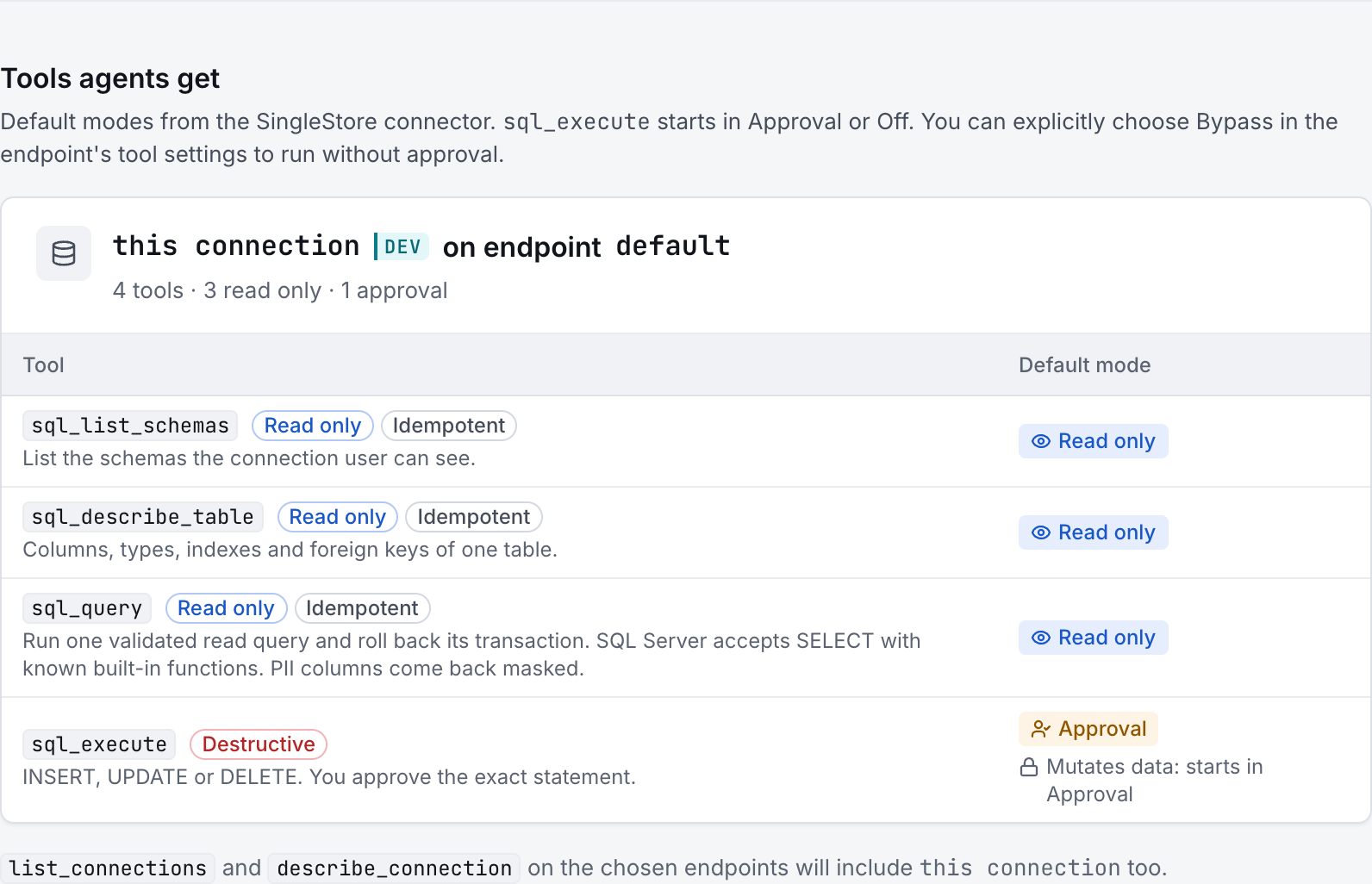
The preview below shows this connector’s default tools before saving. The table explains what each tool can do; connection settings, credentials and endpoint policies can restrict access further.
Start with a small read request. Replace example resource names with existing resources your connection may access. Open Activity after the call to inspect its connection, tool, arguments, policy decision and result metadata.
Ask your AI, for example
- “List tables in my SingleStore database.”
- “Describe the selected SingleStore table.”
- “Aggregate sales by day for the requested period in SingleStore.”
| Tool | What it does | Starts as |
|---|---|---|
sql_list_schemas | List tables and views in the selected MySQL-compatible database, within the connection and policy restrictions. | Read only |
sql_describe_table | Describe a table’s columns, types, keys and indexes where available. | Read only |
sql_query | Run one validated MySQL-compatible read statement in a read-only transaction, then roll it back. Function allowlists, database permissions and output limits apply. | Read only |
sql_execute | Run one supported data or schema change with Approval by default. Database permissions and the environment policy apply; schema changes can commit implicitly. | Approval |
You can change each tool’s mode on the endpoint. Every call your AI makes appears in Activity.